


Customers, promise, evidence and experience: a practical method to structure your own brand before preparing it for expansion.
You have an idea for a retail, food or service business and want to build your own brand in Morocco. It is tempting to start with a name, a logo and a location. Yet a more fundamental decision comes first: why would a customer choose your offer over an alternative, and then come back?
A strong brand connects a clearly defined customer, an understandable promise and an experience the team can actually deliver. This guide offers a practical way to turn an initial idea into a coherent business concept, without confusing brand creation with advertising or franchisee recruitment.
A brand is more than a name or a logo
Visual identity makes a business recognisable. A brand, in the commercial sense, also takes shape through its offer, service, perceived price and the memories customers take away. A striking interior cannot make up for an unclear promise or an inconsistent experience.
The business concept turns that intention into a working format: what you sell, to whom, in what setting and to which standards. Before commissioning a visual identity, you should be able to explain these choices simply. Creative work can then follow a meaningful brief, rather than being expected to invent the underlying business model.
Start with a specific customer situation
“Working people”, “families” and “young people” are too broad to guide every decision. Describe a particular moment instead: someone looking for a dependable lunch during a work break, a parent who needs a predictable after-school service, or a professional trying to save time.
For that situation, observe the options people already use, the constraints they face and the compromises they accept. Speak to prospective customers, including those who do not find your idea appealing. Ask what they do today, what disappoints them and what might make them switch. Detailed accounts of actual behaviour are more useful than a polite “yes, that sounds interesting”.
Write a promise you can deliver
A working statement can follow this structure: “For this customer, in this situation, our brand provides this benefit, supported by this evidence.” It is not an advertising slogan; it is a tool for making choices.
Consider a fictional example, unrelated to any MFV client: a lunchtime counter serving employees in a Casablanca neighbourhood. Its positioning might take the following form:
| Question | Illustrative choice | Practical consequence |
|---|---|---|
| What need? | Lunch without unwelcome surprises | A clear offer and monitored availability |
| What promise? | A straightforward meal and a smooth service | A short ordering journey |
| What evidence? | Organised preparation and consistent hospitality | Working standards and training |
| What do we leave out? | A menu designed to please everyone | A deliberately controlled range |
This is not a universal formula. It shows how a promise can change the way a business operates, rather than just the words it uses.
Turn positioning into practical decisions
Every advertised benefit needs an operational foundation. If you promise personalised advice, allow for the time, skills and tools it requires. If simplicity is central to the brand, check that the offer and purchase journey are genuinely easy to understand.
Also examine the economics: required resources, supply arrangements, service capacity and a price your intended customers can accept. An attractive experience that cannot be sustained day after day needs to be redesigned. This work helps prepare the economic model for a future business or network; it does not replace validated financial assumptions.
The brand platform: a useful brief, not a manifesto
Bring your decisions together in a short document that a future location manager can understand:
- The priority customer and the situation you address.
- The main benefit and the evidence customers can observe.
- The useful differences compared with alternatives.
- The brand’s personality and tone of voice.
- The parts of the experience that must remain consistent.
- The choices you accept and the requests you will not serve.
Words such as “quality”, “innovation” or “closeness” only become useful when they translate into specific behaviour. Replace “a warm welcome” with what a team member should actually do when a customer arrives.
Test the concept before rolling it out
Put the promise to the test in a way that suits the project: an offer presentation, a customer-journey prototype, a service trial or a pilot unit. The aim is not to secure your friends’ approval of the logo. It is to discover what people understand, choose and genuinely experience.
Observe hesitation, recurring questions, abandoned purchases and reasons for returning. Check whether someone other than the founder can deliver the intended experience. Our guide to testing a pilot unit before franchising explores this stage further. A positive trial informs a decision; it does not guarantee a successful rollout.
Choose a name and carry out the relevant checks
The name should be understandable, pronounceable and usable in the languages that matter to your customers. Also check cultural associations, search results and existing uses before committing to permanent materials.
Commercial strategy is not a substitute for legal protection. WIPO explains the importance of distinctiveness in trademark protection. For a project in Morocco, check the applicable procedures with OMPIC and a qualified professional. This guide is not legal advice or a trademark availability search.
Prepare a transferable concept without skipping stages
If you are considering several locations or franchise development, distinguish the brand’s defining features from aspects that may be adapted locally. The core offer, particular service behaviours and quality requirements may be fundamental; other details will depend on the location and customer habits.
Document these choices and how they will be passed on. Recruiting partners to compensate for an unstable concept is premature. Preparing to become a franchisor means working on the concept, its transfer to others and the organisation needed to support development.
A practical roadmap for the first month
- Observe customers and the alternatives they actually use.
- Write an initial promise, including its evidence and the choices it rules out.
- Translate that promise into an offer, a customer journey and service standards.
- Test, record objections and adjust assumptions before making hard-to-reverse spending decisions.
This is a suggested way to organise the work, not a guaranteed timeframe for creating or validating a brand. The appropriate pace depends on the sector and the project’s maturity.
Frequently asked questions
Should we create the logo before testing the offer?
A temporary identity may be enough for early trials. First clarify the positioning and the experience’s practical requirements, so that the final identity supports considered decisions.
Can we think about franchising while creating the brand?
Yes, to anticipate transferability and consistency. However, the ambition to build a network does not remove the need to test the offer and organise how it works.
Is this about choosing an existing franchise to join?
No. It is intended for people developing their own brand or concept, and businesses seeking to structure their expansion.
Your next step: prepare a page describing your target customer, your promise and the evidence behind its value. MFV can discuss how to structure your concept and prepare it for development. The starting point is your own project, not a third-party brand to join.
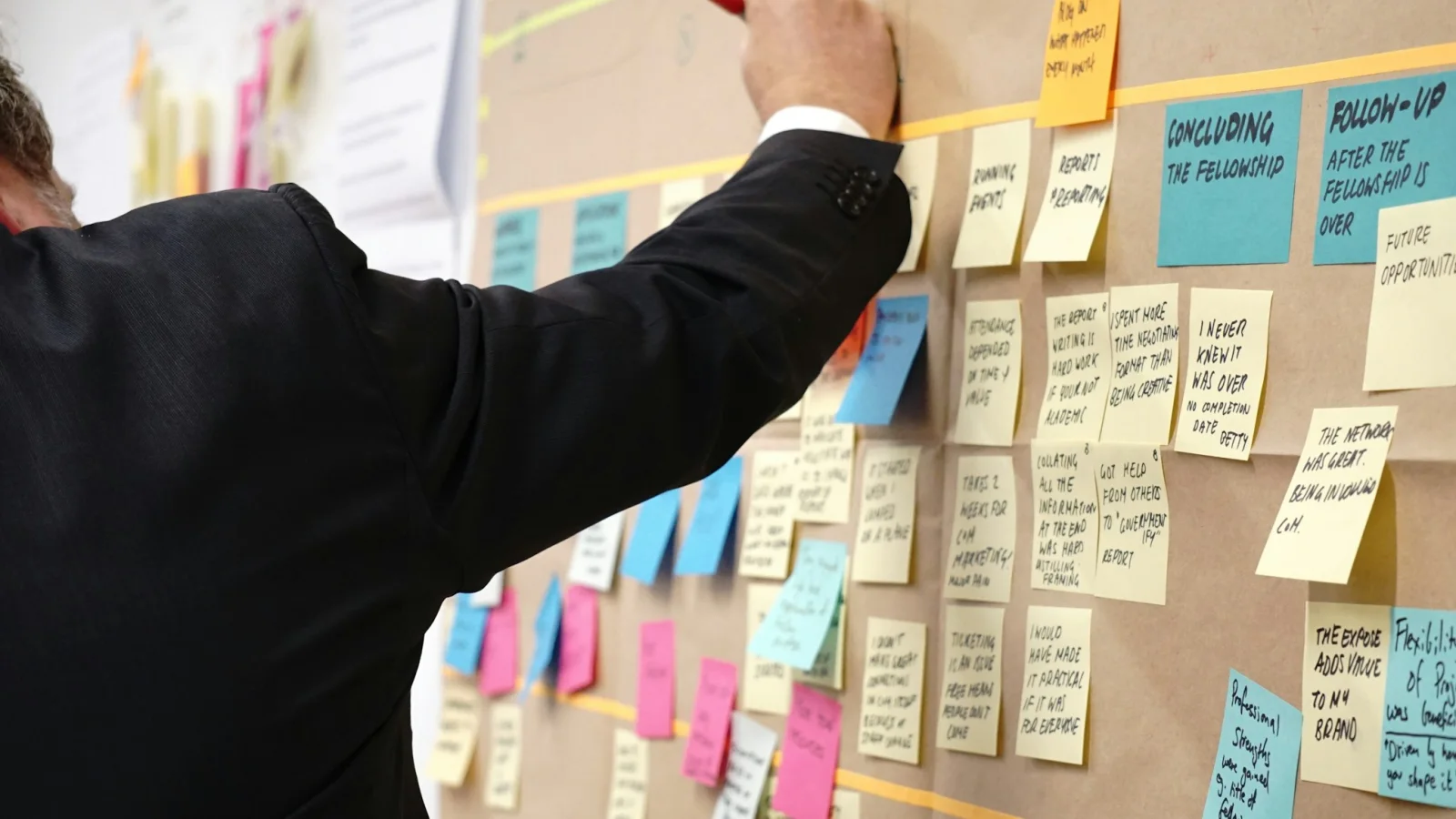
Illustrative photograph: Jo Szczepanska, Unsplash. The scene illustrates a workshop; it does not depict an MFV assignment or team.